
Fresh Milled Sourdough Bread (Soft, Tangy, and So Rewarding)

Fresh milled sourdough bread has a tangy depth and a soft, open crumb that you just don’t get from store-bought loaves. The whole grain flour, ground just before mixing, brings a nutty sweetness and a sturdy crust that makes every slice feel special.

Why This Sourdough Works
I keep coming back to this recipe because the fresh flour gives the bread a richness that aged whole wheat can’t match. The oils in the grain are still lively, so the crumb stays moist for days and the flavor has a mild, almost sweet warmth.
That tangy note you want from sourdough is there too, but it doesn’t overpower the wheat. You taste the grain first, then a gentle lactic brightness. And the crust cracks just right, thin but crisp, because the fresh flour browns fast in the hot Dutch oven.
Ingredients

- 400 g freshly milled hard white wheat flour: milled from hard white wheat berries on the finest setting right before mixing
- 100 g bread flour: gives the dough enough strength to trap gas and rise high
- 350 g water (room temperature): roughly 1 ½ cups; you may need a splash more or less depending on your flour’s thirst
- 100 g active sourdough starter (100% hydration): fed and bubbly, passed the float test
- 10 g fine sea salt: tightens the gluten and balances the tang
Variations / Substitutions
- Use all fresh milled flour: skip the bread flour and use 500 g fresh milled flour. The loaf will be a bit shorter but tastes even nuttier.
- Swap in spelt: replace 100 g of the fresh milled flour with fresh milled spelt for a softer crumb and a more mellow tang.
- Add seeds: knead 40 g of sunflower or pumpkin seeds into the dough after the autolyse for extra crunch.
- No mill, no problem: Use 400 g whole wheat flour and 100 g bread flour instead of fresh milled. The flavor won’t be quite as lively, but you’ll still get a fine loaf.
Rich and Silky Roasted Tomato Soup is a cozy soup to serve with this bread.
How to Make Fresh Milled Sourdough Bread
Step 1: Mix the Flour and Water

In a large bowl, combine the 400 g freshly milled flour and the 100 g bread flour. Pour in the 350 g water and stir with a spatula or your hands until every bit of flour disappears, about 1 minute. Cover the bowl with a damp towel and let it rest at room temperature for 30 minutes.
The dough will look shaggy and feel a little like damp sand, but after that rest the flour will fully hydrate and the difference is striking. This short autolyse jump-starts gluten development and makes the dough much easier to work later.
Step 2: Incorporate the Starter and Salt

Add the 100 g active starter and the 10 g salt to the rested dough. Use wet hands to squish and fold everything together until the starter and salt are evenly distributed, about 2 minutes. Cover again and leave it alone for another 30 minutes before you begin the stretch and folds.
At this point the dough will still look rough, but the smell already hints at something alive. You are not looking for a smooth ball yet, just a cohesive mass with no dry pockets.
Step 3: Bulk Ferment with Stretch and Folds

Keep the dough covered at room temperature (ideally 72 to 76 °F) for 4 to 5 hours total. During the first 2 hours, perform one set of stretch and folds every 30 minutes, for a total of 4 sets. To stretch and fold, grab a side of the dough, lift it straight up, and fold it over the top. Rotate the bowl and repeat until the dough feels tighter and no longer tears easily, usually 4 to 6 folds.
You’ll notice the dough turn silkier and start to trap gas. Bubbles will appear on the surface and the whole mass will dome in the bowl. The bulk ferment is done when the dough has roughly doubled and jiggles when you shake the bowl.
Step 4: Shape the Dough into a Boule

Scrape the dough onto a lightly floured surface. Let it rest for 10 minutes to relax the gluten, then shape it into a tight boule. Pull the outer edges toward the center, flip the dough seam-side down, and use both hands to drag it toward you in small circles until the surface is taut and the dough holds its shape.
Drop the shaped loaf, seam side up, into a well-floured banneton or a bowl lined with a floured tea towel. Pinch the seam gently if it looks loose. The dough should feel plump and full of air, not dense.
Step 5: Score and Bake the Loaf
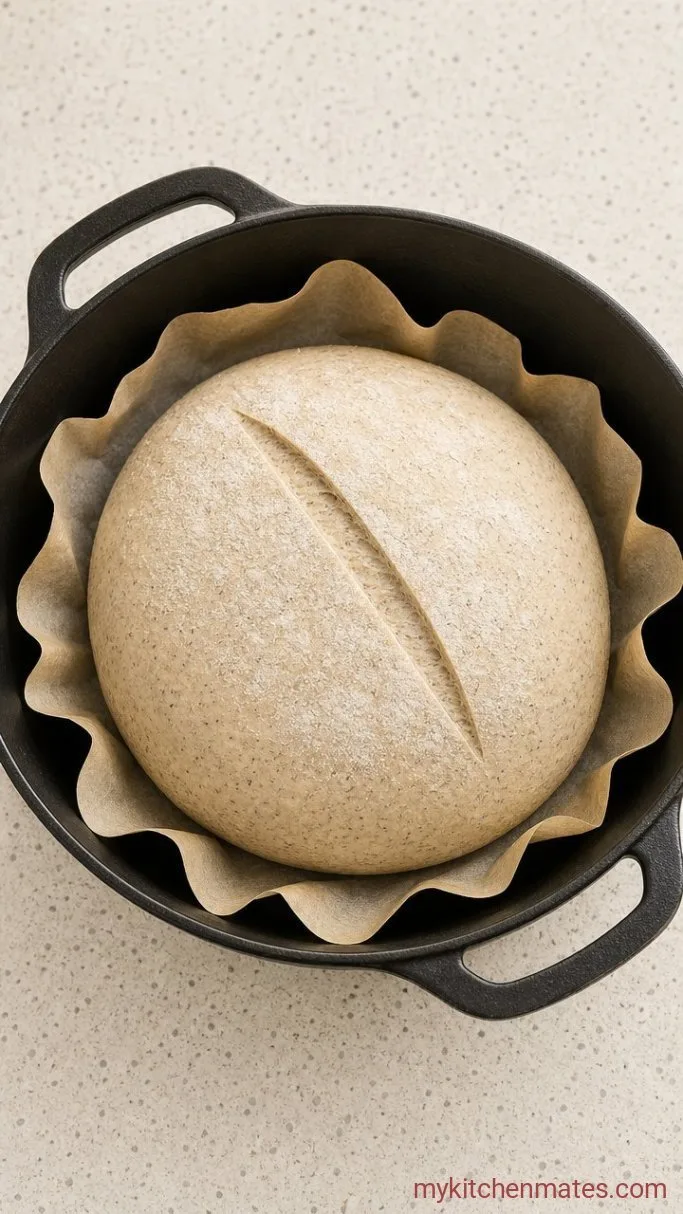
Place a Dutch oven with its lid inside your oven and preheat to 475 °F (245 °C) for at least 30 minutes. After preheating, turn the loaf out onto a piece of parchment paper, seam side down. Slash the top with a sharp lame or razor at a shallow angle, about ¼ inch deep. Carefully lower the loaf into the hot Dutch oven, cover, and bake for 30 minutes. Remove the lid, drop the temperature to 450 °F (230 °C), and bake for another 12 to 15 minutes until the crust is deep amber.
The kitchen will smell like toasted grain and caramel. The loaf is done when it sounds hollow when tapped on the bottom or an instant-read thermometer reads 200 to 205 °F (93 to 96 °C) in the center.
Step 6: Cool and Slice the Bread

Lift the bread out of the Dutch oven and set it on a wire rack. Let it cool for at least 1 hour before you slice; cutting into a hot loaf squishes the crumb and makes it gummy. Once cooled, the crust will be crisp and the inside soft with a glossy, open crumb. Slice it thick and serve with good butter.
Tips for the Best Fresh Milled Loaf
- Mill your wheat berries on the finest setting. Coarsely ground flour acts like bran shards and can slice through gluten strands, giving you a shorter loaf.
- Hold back about 20 g of water when mixing if your flour is extremely fresh (milled within the hour). Fresh flour can be thirstier or more slippery depending on the grain, so watch the dough before adding the rest.
- Judge bulk fermentation by jiggle, not clock time. If your room is cooler than 70 °F, the rise may take 6 or even 7 hours, and that’s fine. Wait for the domed, bubbly look and the wobbly feel.
- If the shaped loaf spreads instead of holding its ball, the gluten didn’t tighten enough during shaping. Stop and re-boule it with a few more drags on the counter.
Bake times by pan and setup:
| Oven setup | Lid or cover | Temp after loading | First bake | Finish bake (uncovered) |
|---|---|---|---|---|
| Dutch oven (5–6 qt) | Covered, then uncovered | 475 °F then 450 °F | 30 min covered | 12–15 min |
| Baking stone with steam | No lid | 475 °F for first 15 min, vent steam, then 450 °F | — | 35–40 min total |
| Loaf pan (9×5 inch) | No lid, tent with foil if browning too fast | 450 °F | 20 min, then tent if needed | 20–25 min |
Keeping Your Bread Fresh
Refrigerate the loaf wrapped in a clean tea towel and placed in a paper bag for up to 3 days; the crust softens a bit but reheating fixes that. Freeze sliced bread in a zip-top bag for up to 3 months and pop slices straight into the toaster. Reheating a whole or half loaf: spritz lightly with water and bake at 350 °F for 8 to 10 minutes to revive the crust.
What to Serve With Fresh Milled Sourdough
A thick slice toasted and rubbed with a garlic clove then drizzled with olive oil is a meal on its own. It also loves a bowl of roasted tomato soup, where the tang of the bread and the sweetness of the tomatoes play off each other. For breakfast, slather it with salted butter and a drizzle of honey, the nutty wheat crumb soaks up the butter without turning soggy.
Frequently Asked Questions
Can I use 100% fresh milled whole wheat flour?
Yes, you can. The loaf will be denser and a bit shorter because the bran sharpens gluten cutting, but the flavor is deeply nutty and worth trying at least once.
Why did my dough feel like a sticky mess?
Fresh milled flour absorbs water differently than aged flour. If the dough is too sticky after the autolyse, resist adding more flour. Wet your hands for stretch and folds instead; the stickiness fades after the first two sets.
My loaf didn’t rise much in the oven. What went wrong?
Almost always an under-fermented dough. If the bulk ferment didn’t double and jiggle, or if the proof was too short, the yeast hadn’t built up enough gas. Push the bulk longer next time, even if it takes 7 hours.
Do I really need to wait an hour before slicing?
Yes, that hour is non-negotiable. The crumb is still setting up, and slicing early leaves you with a gummy, squished loaf instead of the open texture you worked for.
Fresh Milled Sourdough Bread Recipe
Ingredients
Method
- Combine the 400 g fresh milled flour and 100 g bread flour in a large bowl. Pour in 350 g water, stir until no dry bits remain, cover, and rest 30 minutes.
- Add the 100 g starter and 10 g salt, mix with wet hands until evenly distributed, cover, and rest another 30 minutes.
- Bulk ferment 4 to 5 hours at room temperature, doing 4 sets of stretch and folds during the first 2 hours, until the dough doubles and jiggles.
- Shape the dough into a tight boule on a lightly floured surface, rest 10 minutes, then place seam side up in a floured banneton.
- Preheat Dutch oven in a 475 °F oven for 30 minutes. Turn loaf onto parchment, score the top, and bake covered 30 minutes. Uncover, reduce heat to 450 °F, and bake 12 to 15 minutes until deep amber.
- Cool on a wire rack at least 1 hour, then slice and serve.
Notes
