
Crusty Overnight Sourdough French Bread

This sourdough French bread has a shatteringly crisp crust and an open, chewy crumb, all from just flour, water, starter, and salt. It relies entirely on a natural sourdough ferment, so no packet yeast gets involved.

The dough does a long cold rest overnight, which builds deep, tangy flavor while you sleep. The next day you shape it, let it puff up, and bake it until the kitchen smells like a bakery.
Why This Bread Works
That crust is the real deal. A hot oven plus a burst of steam gives you the kind of crackle you hear when you press the loaf, and the crumb inside stays soft and irregular with plenty of holes for butter.
Because the bulk of the rising happens slowly in the fridge, the dough develops complexity without demanding constant attention. It is low effort on baking day, and the only equipment you need is a kitchen scale and a hot oven.
Ingredients

- 500g bread flour: higher protein gives the loaf good structure and chew.
- 350g water, room temperature: 70% hydration keeps the crumb open without making the dough impossible to handle.
- 100g active sourdough starter: bubbly and at its peak, so it has enough power to lift the dough.
- 10g fine sea salt: seasons the dough and tightens the gluten network.
Variations / Substitutions
- Whole wheat swap: replace up to 100g of the bread flour with whole wheat for a nuttier loaf; you may need an extra 10g of water.
- Herb addition: work 2 tsp dried herbes de Provence into the dough with the salt for a savory twist.
- Seeded crust: after shaping, roll the loaf in a mix of sesame and poppy seeds before the final proof.
- All-purpose flour: you can use it in place of bread flour, but the crumb will be slightly less chewy.
Rich, Caramelized French Onion Soup makes a comforting soup to pair with this bread.
How to Make Sourdough French Bread
Step 1: Mix the Autolyse

In a large bowl, combine the 500g bread flour and 350g water. Mix with your hand or a dough whisk just until no dry flour remains. The mixture will look shaggy and feel stiff. Cover the bowl and let it rest at room temperature for 30 minutes. This rest lets the flour fully hydrate before you add the starter, which shortens the kneading later.
Step 2: Add Starter and Salt

Scrape the 100g active starter and 10g salt onto the rested dough. With wet hands, pinch and squeeze the dough repeatedly to work the starter and salt in. It will come apart at first, then turn sticky and uniform after about 2 minutes of mixing. Once everything is incorporated, cover the bowl again.
Step 3: Stretch, Fold, and Refrigerate

Over the next 2 hours, give the dough three sets of stretch and folds, one every 40 minutes. For each set, wet one hand, grab a corner of the dough under the surface, stretch it upward, and fold it over the center. Rotate the bowl a quarter turn and repeat until you have done four folds. The dough will feel smoother and tighter after each round. After the third set, cover the bowl tightly and place it in the refrigerator. Leave it to ferment slowly for 12 to 18 hours. The next morning the dough will have risen significantly and look domed with a few small bubbles on top.
Step 4: Shape the Loaf

Scrape the cold dough onto a lightly floured counter. Use a bench scraper to gently shape it into a round and let it relax for 20 minutes, uncovered. Then dust the top with flour, flip it over, and stretch it gently into a rough rectangle. Fold the top third down to the middle and the bottom third up, like a letter, then use both hands to roll the dough away from you to build tension. Pinch the seam closed. Place the shaped loaf seam side down on a piece of parchment paper.
Step 5: Proof the Loaf
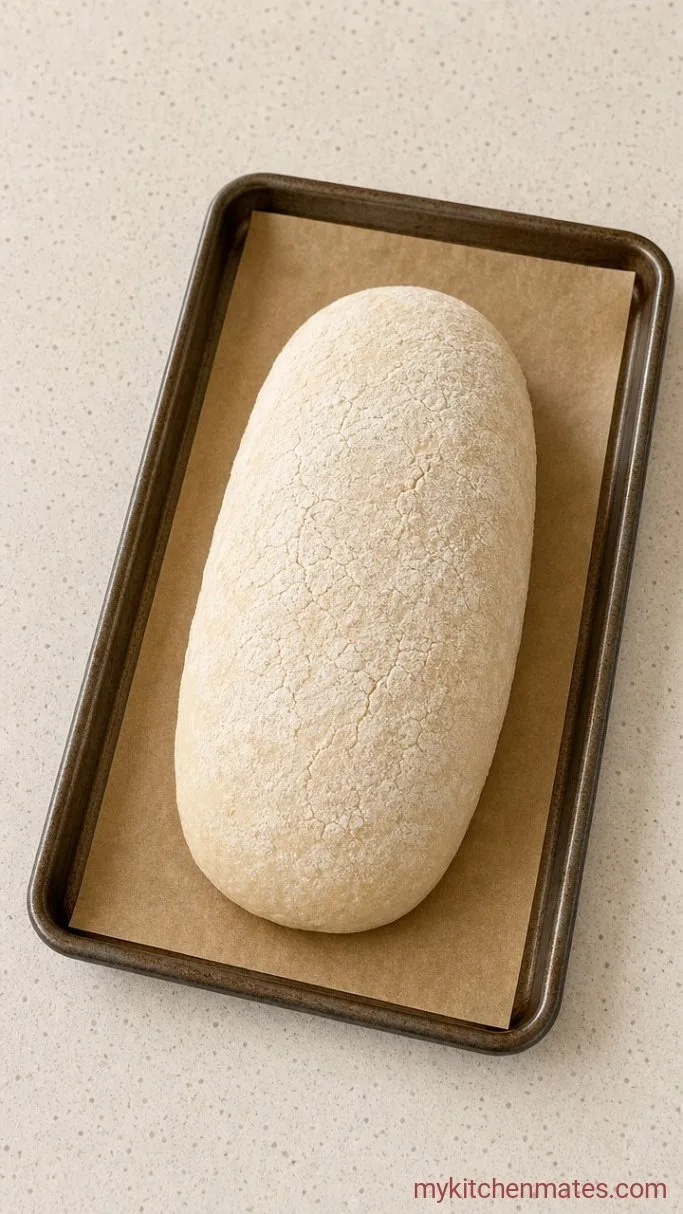
Slide the parchment with the loaf onto a baking sheet or leave it on the counter. Cover it loosely with a clean tea towel and let it proof at room temperature. Depending on your kitchen temperature, this will take 1 to 2 hours. The loaf is ready when it has grown by about half and a gentle poke with a floured finger springs back slowly, leaving a shallow indent.
Step 6: Score and Bake

Place your baking stone or overturned sheet pan in the oven and preheat to 475°F (245°C) for at least 30 minutes. Put a metal pan on the lowest rack to hold water for steam. When the oven is hot, use a sharp lame or serrated knife to score the top of the loaf with one long, shallow slash at a 45-degree angle. Slide the parchment and loaf onto the hot stone, pour a cup of hot water into the steam pan below, and quickly close the door. Bake with steam for 25 minutes, then remove the steam pan, lower the temperature to 450°F (230°C), and bake another 10 to 15 minutes. The loaf is done when the crust is a deep mahogany brown and a thermometer inserted into the center reads 205°F (96°C).
Step 7: Slice and Serve the Bread
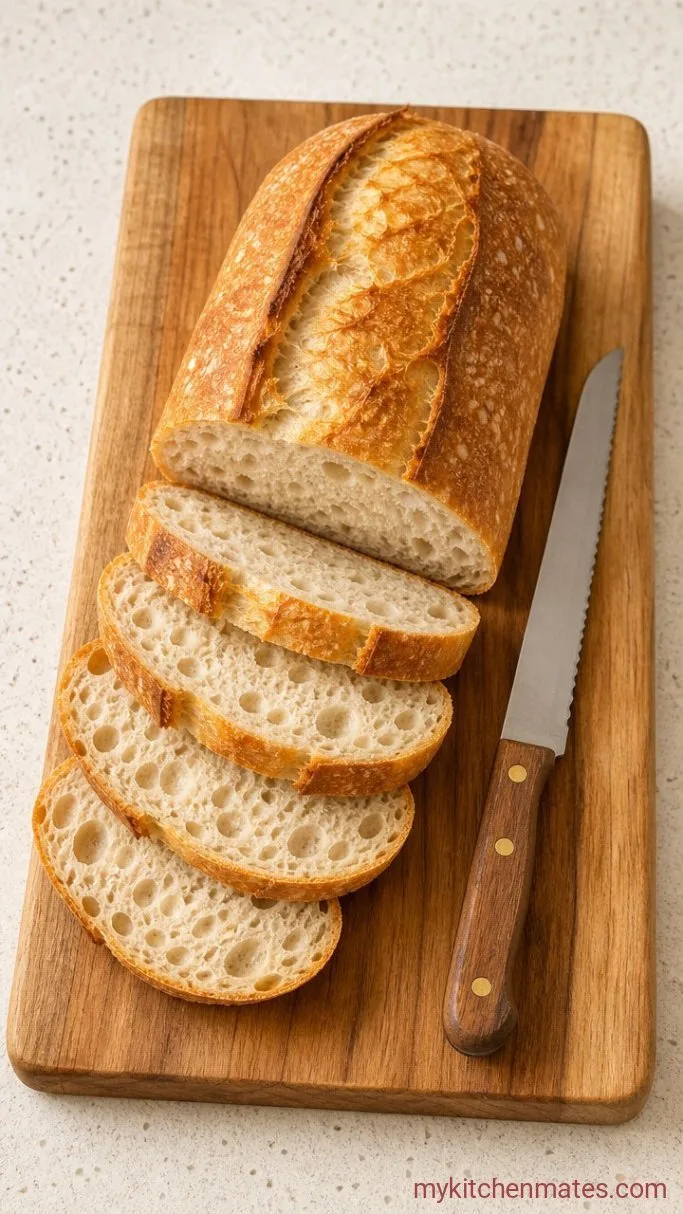
Transfer the loaf to a wire rack and let it cool completely, at least 1 hour, before you cut into it. Cooling lets the crumb set so you do not get a gummy slice. Slice with a long serrated knife and serve warm, or toast it the next day. The crust will crackle under the blade.
Tips for the Best Crust
- Use a digital scale. Volume measurements for flour and water are not precise enough to nail the 70% hydration, and an overly wet or dry dough changes the crumb and shape.
- Wait until your starter passes the float test. Drop a pea-sized bit into a glass of water before mixing. If it floats, it is ready; if it sinks, feed it again and wait.
- For extra steam, toss three ice cubes onto the oven floor right after loading the bread. The slow melt creates steam longer than a pan of water that boils off fast, giving you a thicker, blistered crust.
- If your loaf browns too quickly, tent it loosely with foil after the steam phase is over, but wait until it has proper color before you cover it.
Bake times by oven setup:
| Setup | First bake (with steam) | Second bake (dry) | Total time |
|---|---|---|---|
| Baking stone | 475°F, 25 min | 450°F, 10-15 min | 35 to 40 min |
| Dutch oven | 500°F, 20 min covered | 450°F, 15-20 min | 35 to 40 min |
| Sheet pan | 475°F, 25 min | 450°F, 10-15 min | 35 to 40 min |
Keeping Your Bread Fresh
- Room temperature: store the loaf cut side down on a wooden board or in a paper bag for up to 2 days. A plastic bag traps moisture and softens the crust.
- Freezing: slice the bread first, then freeze the slices in a zip-top bag. Toast them directly from frozen, and they revive the crunch.
- Reheating: to refresh a whole loaf, mist it lightly with water and warm it in a 350°F (175°C) oven for 10 minutes. The crust will crisp back up.
What Goes Well With Sourdough French Bread
This bread is a natural match for a bowl of creamy roasted tomato soup because the tangy crumb cuts through the richness without getting soggy. Slice it thick for bruschetta in summer, since the open crumb soaks up olive oil and tomato juices beautifully. A classic French onion soup also works: the sturdy crust holds up under a blanket of melted Gruyère.
Frequently Asked Questions
Can I use all-purpose flour if I don’t have bread flour?
Yes, all-purpose flour works. The loaf will be a little less chewy and may not spring up quite as high in the oven, but the flavor will still be excellent.
Do I have to refrigerate the dough overnight?
You can proof it at room temperature for 4 to 6 hours instead, but the bread will have a milder sourdough tang. The cold ferment also makes the dough easier to shape.
My loaf came out flat. What went wrong?
Usually that means the dough overproofed or the starter was not strong enough. Next time, use your starter at its peak and watch the loaf during the final proof so it does not double in size, just puffs by half.
How can I tell the bread is fully baked without a thermometer?
Tap the bottom of the loaf; it should sound hollow, like a drum. A dull thud means the center is still doughy, so return it to the oven for another 5 minutes.
Sourdough French Bread Recipe
Ingredients
Method
- Mix flour and water until no dry bits remain. Cover and rest 30 minutes.
- Add starter and salt, pinch to combine, then cover.
- Give 3 sets of stretch and folds over 2 hours, then cover tightly and refrigerate 12 to 18 hours.
- Turn out cold dough, preshape, rest 20 minutes, then shape into a tight batard.
- Cover and proof at room temperature until puffy, 1 to 2 hours.
- Score top, slide onto a preheated stone at 475°F with steam. Bake 25 minutes, remove steam, reduce to 450°F, and bake 10 to 15 minutes.
- Cool on a rack at least 1 hour, then slice and serve.
Notes
