
Olive Sourdough Bread with a Crackly Crust

This olive sourdough bread delivers a deep, tangy crumb studded with salty olives and a glossy, crackling crust that shatters when you slice it.
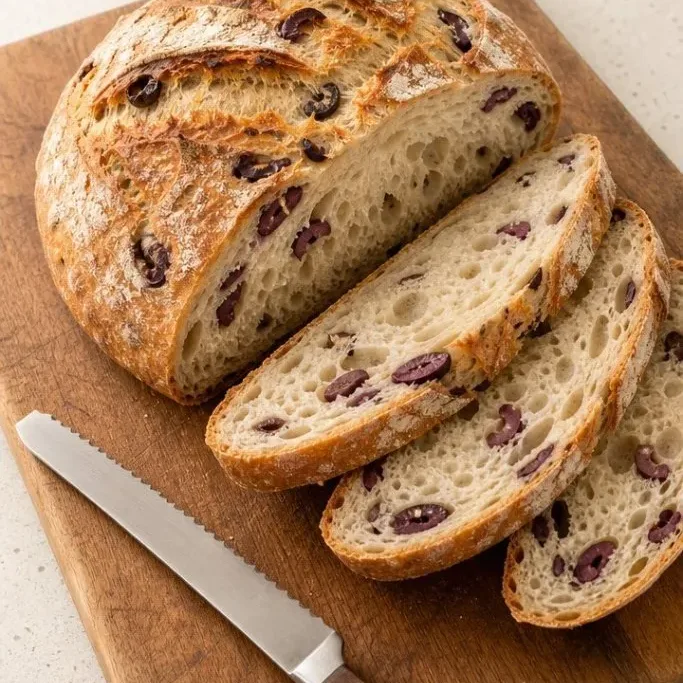
It is the loaf I bake when I want something that feels special but comes together with an active starter and a few folds over an afternoon.
Why This Olive Loaf Works
The olives add pockets of brine that play against the sourdough’s natural tang without overpowering it. I reach for Kalamatas because their meaty texture holds its shape through the long ferment.
A high-hydration dough gives the crumb that mix of chew and irregular holes you want in a rustic loaf. The long, cool bulk proof deepens the flavor so you taste the starter, not just the salt.
Ingredients

- 450 g bread flour: gives the loaf structure and a strong rise
- 50 g whole wheat flour: adds a little nuttiness and helps with fermentation
- 375 g warm water (90 °F / 32 °C): enough for a 75% hydration dough
- 100 g active sourdough starter (100% hydration): fed 4 to 6 hours earlier, bubbly and domed
- 10 g fine sea salt: use a light hand if your olives are very briny
- 150 g pitted Kalamata olives, drained and patted dry: chop them roughly so they distribute without tearing the dough
Variations / Substitutions
- Use a different olive: Castelvetrano or oil-cured black olives work well, just rinse and dry them thoroughly to avoid a soggy loaf.
- Go all bread flour: Skip the whole wheat and use 500 g bread flour. The crust will be a shade paler and the crumb slightly less rustic.
- Swap the starter share: If your kitchen is warm, drop the starter to 80 g and extend the bulk time. In a cold kitchen, bump it to 120 g.
- Add fresh herbs: Fold in 1 tablespoon finely chopped rosemary or thyme with the olives for an earthy backbone.
Cabbage Diet Soup for a 10-Pound Reboot is a cozy soup to serve with this bread.
How to Make Olive Sourdough Bread
Step 1: Mix the Autolyse

Combine the 450 g bread flour, 50 g whole wheat flour, and 375 g warm water in a large bowl. Mix with your hand until no dry bits remain, cover with a damp towel, and rest for 45 minutes. This rest lets the flour fully hydrate and starts gluten development before the starter goes in.
After the autolyse, the mixture will look shaggy but will feel noticeably softer and easier to stretch. That softness is your cue that the dough is ready for the next addition.
Step 2: Add the Starter, Salt, and Olives

Add the 100 g active starter and 10 g salt to the bowl. Squeeze and fold the dough with your hand for about 3 minutes, working everything together until the starter is completely incorporated and the dough begins to feel smooth and slightly tacky. Scatter the 150 g chopped olives over the top and fold them in firmly, pinching and pressing until they are evenly distributed.
The dough will look speckled and feel a little oily from the olives. That is normal, and within a few folds the olive pieces will stay put instead of sliding out.
Step 3: Fold and Stretch Over the Bulk Fermentation

Cover the bowl and let the dough rise at a room temperature around 72 °F (22 °C) for 4 to 5 hours. During the first 2 hours, perform a set of stretch and folds every 30 minutes, four sets total. To do a fold, lift one side of the dough, stretch it up, and fold it over the top. Rotate the bowl a quarter turn and repeat until you have done all four sides.
With each set you will feel the dough tighten and hold its shape better. By the fourth fold it should feel pillowy and resist pulling. If your kitchen runs cool, stretch the bulk time to 6 hours and watch for a 40 percent increase in volume.
Step 4: Shape the Dough

Lightly flour a work surface and turn the dough out gently, trying not to deflate it too much. Shape it into a tight round by folding the edges toward the center, then use your fingers to drag the dough across the bare counter, building tension on the outside. Place the round seam side up in a floured banneton or a bowl lined with a floured tea towel.
Cover and let the shaped loaf proof until it passes the poke test. Press a floured finger about half an inch into the dough. If the indentation springs back slowly and leaves a slight dent, the dough is ready to bake, usually 1 to 2 hours at room temperature or overnight in the refrigerator for a deeper flavor.
Step 5: Score and Bake

Set a Dutch oven with its lid into the oven and preheat to 450 °F (230 °C) for at least 30 minutes. Turn the proofed dough out onto a piece of parchment paper and dust the top with a little flour. Use a sharp lame or a serrated knife to score a deep slash, about half an inch deep, across the loaf. This directs the spring and keeps the crust from splitting wildly.
Carefully lower the loaf into the hot Dutch oven, cover it, and bake for 30 minutes. Remove the lid and continue baking for another 18 to 22 minutes, until the crust is deep amber and sounds hollow when you knock the bottom.
Step 6: Cool and Slice

Transfer the loaf to a wire rack and resist cutting into it for at least 1 hour. The steam inside is still setting the crumb, and cutting too early leaves a gummy texture. Once cooled, slice into thick pieces with a serrated knife and listen for that crackle.
A Few Notes Before You Bake
- If your starter hasn’t doubled within 4 to 6 hours of feeding, the loaf will struggle to rise. Float a spoonful in water before mixing, and if it sinks, give the starter another feed.
- Dough that feels too sticky during the early folds usually just needs a few more sets. Avoid adding extra flour unless the dough is soupy and won’t hold any shape at all.
- A well-scored loaf springs tall and opens a dramatic ear. Cut at a shallow 30-degree angle and keep the blade confident, not tentative.
- Leftover slices revive beautifully when warmed in a 375 °F oven for 5 minutes, which brings the crust back to a shatter.
Bake times and temperatures for your method:
| Method | Covered Temp & Time | Uncovered Temp & Time |
|---|---|---|
| Dutch oven | 450 °F (230 °C) for 30 mins | 450 °F (230 °C) for 18 – 22 mins |
| Baking stone with steam pan | 475 °F (245 °C) with steam for 20 mins | 450 °F (230 °C) for 20 – 25 mins |
Storing and Reheating Leftovers
- Refrigerate: Wrap the cooled loaf in a clean kitchen towel and place it in a paper bag. It stays fresh for up to 3 days.
- Reheating: To bring back a crisp crust, place slices directly on the oven rack at 375 °F (190 °C) for about 5 minutes. A quick toast works too, but you lose the contrast between shell and soft crumb.
- Serve cold: This bread tastes wonderful at room temperature alongside a cheese board or dipped into good olive oil.
What to Serve with Olive Sourdough Bread
A bowl of garlicky white bean soup soaks into the crumb without making it soggy, and the clean flavor balances the olive’s salinity. For something hearty, pair thick slices with a runny poached egg and a pile of peppery greens. The sourdough’s tang also stands up to a soft, funky cheese like a ripe Camembert, where the olive notes echo the cheese’s earthy edge.
Frequently Asked Questions
My dough feels rock hard and won’t stretch. What went wrong?
Your flour likely absorbed more water than expected. Next time, hold back 25 g of water at the autolyse stage and add it only if the dough feels tight after the first fold.
Can I use a different type of olive?
Yes, oil-cured or Castelvetrano olives bring a milder, buttery note. Avoid olives packed in heavy brine unless you rinse and dry them thoroughly, or the extra salt will slow fermentation.
Why didn’t my loaf spring in the oven?
The most common reason is overproofing during the final rise. If the dough deflates when you score it, the structure was weak. A tight Dutch oven lid also traps the steam needed for that initial spring.
Can I add cheese without ruining the crumb?
Yes, fold in 100 g of cubed sharp provolone or aged cheddar right after the olives. The cheese melts into little pockets, so use a firm, low-moisture cheese so it does not grease the dough.
Olive Sourdough Bread Recipe
Ingredients
Method
- Mix the bread flour, whole wheat flour, and warm water in a bowl until no dry spots remain. Cover and rest for 45 minutes.
- Add the starter, salt, and olives. Squeeze and fold for 3 minutes until the starter is fully worked in and the olives are evenly distributed.
- Cover and bulk ferment at room temperature for 4 to 5 hours. Perform 4 sets of stretch and folds at 30-minute intervals during the first 2 hours.
- Turn the dough onto a lightly floured surface and shape into a tight round. Place seam side up in a floured banneton, cover, and proof for 1 to 2 hours until the dough passes the poke test.
- Preheat a Dutch oven at 450 °F (230 °C) for at least 30 minutes. Turn the dough onto parchment, score a deep slash, and bake covered for 30 minutes. Remove the lid and bake another 18 to 22 minutes until deeply amber.
- Cool on a wire rack for at least 1 hour before slicing. Use a serrated knife and enjoy the crackle.
Notes
