
Baked German Chocolate Cheesecake with Gooey Coconut-Pecan Swirl

This baked German chocolate cheesecake takes everything you love about the iconic layer cake and folds it into a creamy, fudgy dessert. A chocolate cookie crust holds a rich chocolate batter, and a thick coconut-pecan caramel swirl bakes right into the top, just like the real frosting.
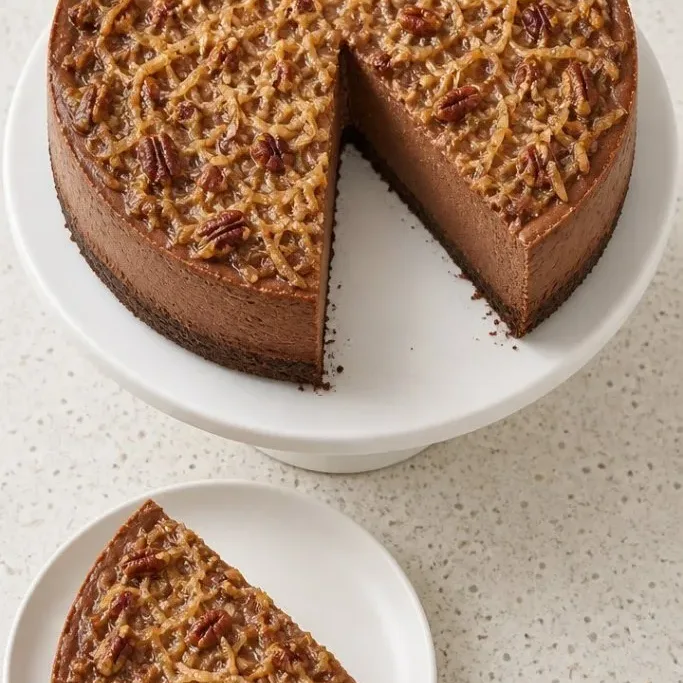
It looks impressive but comes together with a few simple bowls, no water bath required. The cheesecake sets up silky and dense, and the topping gets chewy and toasty in the oven.
Why This Cheesecake Always Works
The chocolate part is deeply cocoa-forward, not just sweet. I use bittersweet chocolate in the filling so it stands up to all that gooey coconut-pecan goodness without tasting cloying.
That coconut-pecan swirl is the real star. It’s a quick stovetop mixture of brown sugar, butter, evaporated milk, egg yolks, coconut, and pecans. When it bakes, it turns into a glossy, chewy ribbon that caramelizes around the edges.
I make this for birthdays and holidays because it slices cleanly and holds up for days. The leftovers, if you have any, get even better after a night in the fridge.
Ingredients
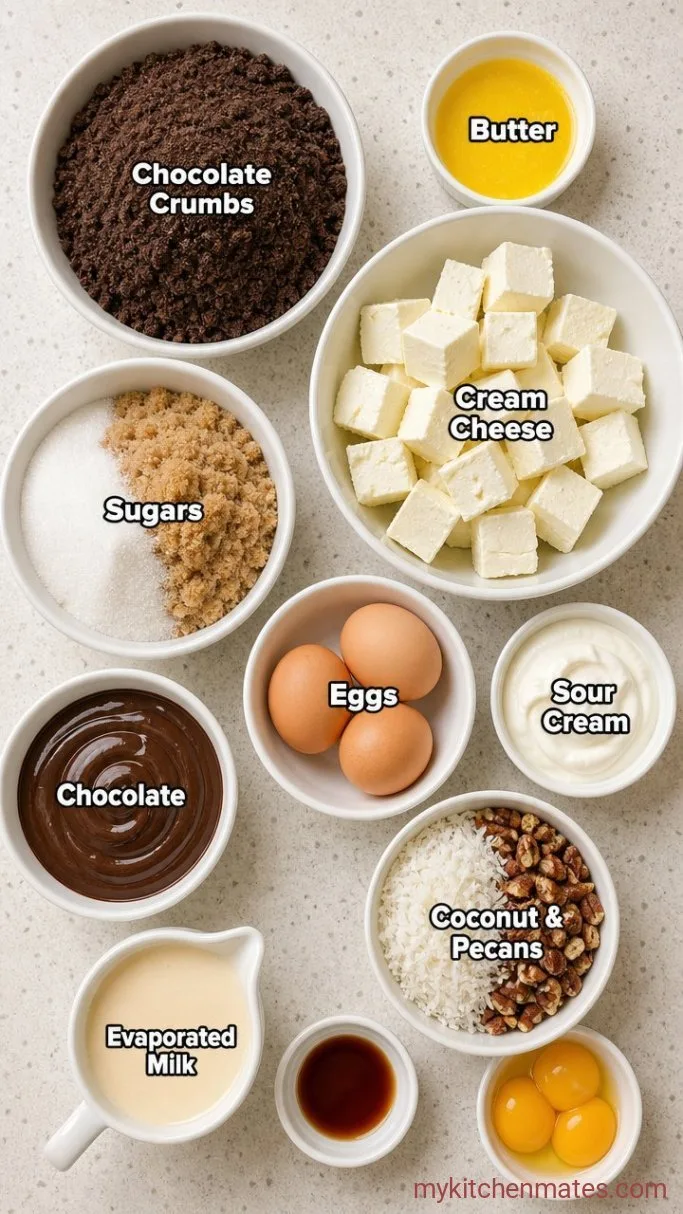
- 1 1/2 cups chocolate wafer crumbs: from about 30 wafers, or use Oreo crumbs with the filling scraped off
- 5 tbsp unsalted butter, melted: plus a little extra for the pan
- 24 oz cream cheese, room temperature: use full-fat brick cream cheese, not spreadable tubs
- 1 cup granulated sugar: divided between the filling and the swirl
- 3 large eggs, room temperature
- 1/2 cup full-fat sour cream, room temperature
- 2 tsp vanilla extract
- 4 oz bittersweet chocolate, melted and slightly cooled: 60 to 70 percent cacao works best
- 3 large egg yolks: for the coconut-pecan mixture
- 1/2 cup packed light brown sugar
- 1/2 cup evaporated milk
- 4 tbsp unsalted butter: for the swirl
- 1 tsp vanilla extract: for the swirl
- 1 1/4 cups sweetened shredded coconut
- 1 cup chopped pecans
Variations / Substitutions
- Milk chocolate swap: Use milk chocolate for a sweeter filling, but cut the sugar in the cheesecake to 3/4 cup so it doesn’t overpower.
- Gluten-free crust: Use gluten-free chocolate wafer cookies or almond flour cookie crumbs. The rest of the recipe is naturally gluten-free.
- Dairy-free option: Swap in dairy-free cream cheese, sour cream, and plant-based butter. Use full-fat coconut milk instead of evaporated milk; the swirl will be slightly softer.
- Nut-free version: Omit the pecans and use an extra 1/2 cup coconut. The texture will be chewier all the way through, but still delicious.
- No cookie crumbs: A graham cracker crust works just as well; use 1 1/2 cups graham crumbs and add 2 tbsp sugar.
Chocolate Caramel Poke Cake is another reader favorite dessert worth making next.
How to Make German Chocolate Cheesecake
Step 1: Press the Crust

Preheat your oven to 325°F (160°C). Butter the bottom and sides of a 9-inch springform pan. In a bowl, stir the 1 1/2 cups chocolate wafer crumbs with the 5 tablespoons melted butter until the mixture looks like wet sand. Press it firmly into the bottom of the pan and just barely up the sides. I use the bottom of a flat measuring cup to pack it down evenly.
You’ll know it’s ready when the surface feels compact and doesn’t crumble away. The butter should be fully incorporated, leaving no dry pockets. A good crust doesn’t just line the pan; it becomes a sturdy base that slices without shattering.
Bake the crust for 10 minutes, then set it aside to cool while you make the filling. Don’t skip this quick bake. It sets the crust so it stays crisp under all that creamy weight.
Step 2: Mix the Chocolate Filling

Lower the oven to 300°F (150°C). In a large bowl or stand mixer, beat the 24 oz cream cheese on medium speed until it’s absolutely smooth, about 2 minutes. Stop to scrape the bowl and paddle often. Any lumps at this stage will stay in your finished cheesecake.
Add 3/4 cup of the granulated sugar and beat until the mixture looks fluffy and pale, another 2 minutes. Then mix in the 3 large eggs one at a time, just until each yolk disappears. Overbeating the eggs is the quickest way to a puffy cheesecake that cracks, so keep the mixer on low here. Blend in the 1/2 cup sour cream and 2 teaspoons vanilla. Finally, fold in the melted bittersweet chocolate, stirring by hand until no white streaks remain.
The batter will be thick and glossy, almost like a chocolate mousse. Taste it if you want, but the sugar balances out once all that coconut-pecan topping bakes on top.
Step 3: Cook the Coconut-Pecan Swirl

In a medium saucepan, whisk the 3 egg yolks, 1/2 cup brown sugar, 1/2 cup evaporated milk, and 4 tablespoons butter over medium heat. Stir constantly with a silicone spatula until the mixture thickens and coats the back of a spoon, about 5 to 7 minutes. It will go from thin to pudding-like pretty quickly.
Take the pan off the heat and stir in the remaining 1/4 cup granulated sugar, 1 teaspoon vanilla, the 1 1/4 cups shredded coconut, and 1 cup chopped pecans. Let it cool for 10 minutes. The swirl will thicken further as it sits, turning into a scoopable, sticky mass. Don’t worry if it looks a little loose; it sets up beautifully in the oven.
This is the exact same filling I use for classic German chocolate cake, just scaled down. It’s chewy, buttery, and full of toasted pecan pieces.
Step 4: Layer and Swirl
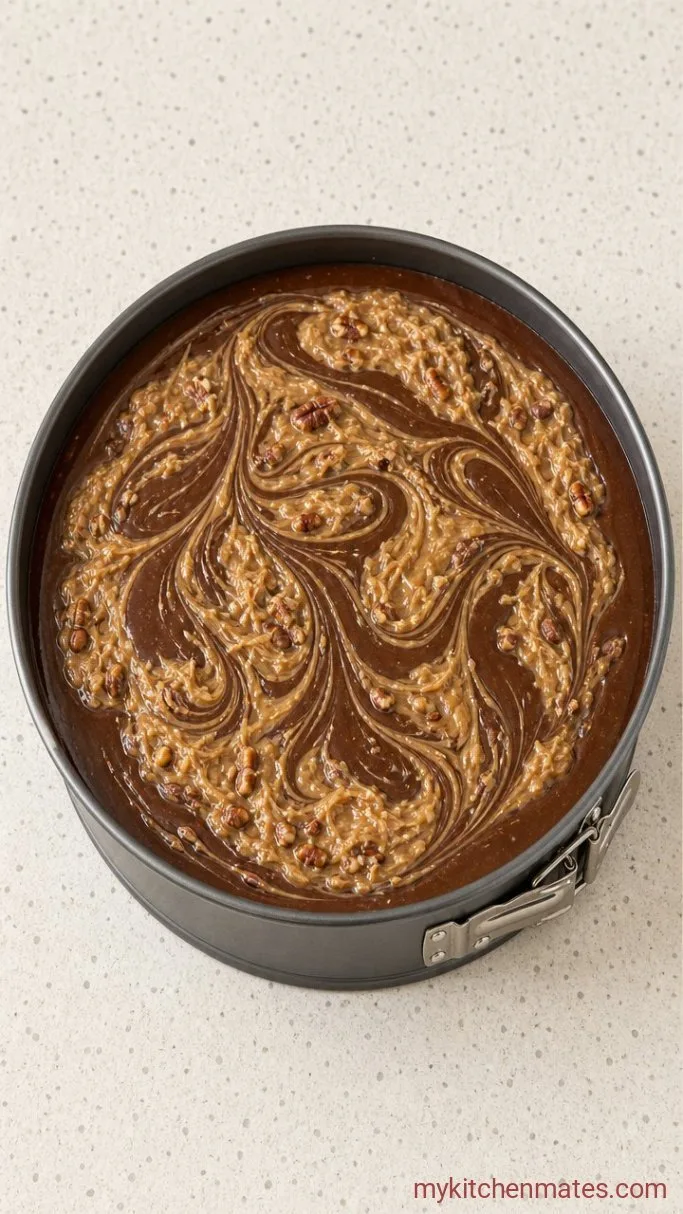
Pour about two thirds of the chocolate cheesecake batter over your cooled crust and spread it to the edge with an offset spatula. Dollop half of the coconut-pecan mixture in spoonfuls across the top, then use a butter knife to gently swirl it into the batter. Don’t mix too deep; you want ribbons, not a fully blended layer.
Spoon the remaining cheesecake batter over that and spread it as evenly as you can. It’s okay if a few swirl bits peek through. Top with the rest of the coconut-pecan mixture, dropping it in clumps. Swirl lightly one more time, just breaking the surface. The uneven top will bake into a gorgeous craggy pattern that looks intentionally rustic.
At this point the pan will be quite full. That’s fine; the cheesecake won’t rise much. Just make sure the springform is locked tight so nothing leaks.
Step 5: Bake the Cheesecake

Place the springform on a baking sheet to catch any stray drips and slide it into the 300°F (150°C) oven. Bake until the edges are set but the center still wobbles like soft-set custard when you nudge the pan, about 60 to 70 minutes for a 9-inch pan. An instant-read thermometer stuck into the middle should register around 155°F (68°C) if you want to be exact.
The cheesecake will puff slightly and the coconut on top will turn deep golden and toasted. You’ll smell the caramelized sugar and pecan fragrance all through the kitchen well before the timer goes off.
Turn the oven off, crack the door open a few inches, and leave the cheesecake inside for 1 hour. This slow cool-down is the main trick for preventing cracks. After that, move it to the counter until fully cooled, then refrigerate uncovered for at least 4 hours, or overnight.
Step 6: Unmold and Slice the Cheesecake

Run a warm offset spatula or thin knife around the inside edge of the springform to release the crust. Unclip the ring and lift it off slowly. If you chilled the cheesecake thoroughly, the sides will be perfectly clean and the swirl will hold its shape.
Use a long, sharp knife dipped in hot water and wiped dry between cuts to slice. Each piece should show off the dark chocolate base, the creamy middle, and that glossy layer of coconut-pecan on top. Serve straight from the fridge for the cleanest slices, or let the cheesecake sit at room temperature for 20 minutes for a softer bite.
The topping will be chewy, the pecans crunchy, and the chocolate layer dense and cold. That’s the moment you’ve been waiting for.
Tips for the Smoothest Cheesecake
- Cold cream cheese is the enemy: Let it sit on the counter for at least 2 hours before you start. Even 30 seconds in the microwave to take the chill off helps, but don’t let it get warm.
- Don’t overwhip the eggs: Mix them in one at a time on low speed. Too much air forces the cheesecake to puff and then collapse, leaving cracks.
- A water bath isn’t necessary here: The low 300°F bake and slow cooling step keep the top flat without the fuss of foil and boiling water.
- The jiggle test is foolproof: Give the pan a gentle shake. If just a 2-inch circle in the very center wobbles, it’s done. The cheesecake will continue to set as it cools in the oven.
- Let the swirl cool before using: Hot swirl straight from the stove will melt the cheesecake batter on contact. Ten minutes of cooling gives you distinct ribbons instead of a muddy mix.
Bake times by pan size:
| Pan size | Bake time range |
|---|---|
| 8-inch springform | 70 to 80 minutes |
| 9-inch springform | 60 to 70 minutes |
| 10-inch springform | 50 to 60 minutes |
Storing and Freezing Leftover Cheesecake
- Refrigerate: Cover the cheesecake loosely with plastic wrap once chilled, or transfer slices to an airtight container. It keeps well for up to 5 days.
- Serve cold: The texture is best straight from the fridge, but you can let it sit out for 20 to 30 minutes to soften a bit. I prefer it fridge-cold with the topping still firm and chewy.
- Freezing: Wrap the whole cheesecake or individual slices tightly in a layer of plastic wrap and then foil. Freeze for up to 2 months. Thaw overnight in the refrigerator before serving.
Frequently Asked Questions
Can I use milk chocolate instead of bittersweet?
Yes, but the cheesecake will be noticeably sweeter. Reduce the sugar in the filling to 1/2 cup to keep it balanced.
Why did my cheesecake crack?
Most cracks come from overbeating the eggs or cooling the cheesecake too quickly. Mix on low speed and let it cool in the turned-off oven with the door cracked, as directed.
Can I make this without a springform pan?
A springform is best for clean removal, but you can use a deep 9-inch cake pan lined with parchment paper and foil. Unmolding will be trickier, so serve slices right from the pan if that’s easier.
How do I know when the cheesecake is really done?
Look for a set edge that spans about 2 inches inward, and a center that jiggles like softly set gelatin when shaken. An instant-read thermometer in the middle should read around 155°F (68°C).
Can I freeze the whole cheesecake, swirl and all?
Absolutely. The coconut-pecan topping freezes beautifully without getting soggy. Wrap well and thaw in the fridge overnight; the texture will be just as good as the day you baked it.
German Chocolate Cheesecake Recipe
Ingredients
Method
- Preheat oven to 325°F (160°C). Butter a 9-inch springform pan. Mix wafer crumbs and 5 tbsp melted butter, press into bottom of pan, and bake for 10 minutes. Set aside to cool.
- Lower oven to 300°F (150°C). Beat cream cheese until smooth, add 3/4 cup granulated sugar, then eggs one at a time. Mix in sour cream and 2 tsp vanilla. Fold in melted chocolate.
- Whisk egg yolks, brown sugar, evaporated milk, and 4 tbsp butter in a saucepan over medium heat until thickened, 5-7 minutes. Remove from heat, stir in remaining 1/4 cup sugar, 1 tsp vanilla, coconut, and pecans. Cool 10 minutes.
- Layer two-thirds of batter into crust, dollop half of swirl, and swirl with a knife. Top with remaining batter and remaining swirl, then lightly swirl again.
- Bake until edges are set and center wobbles gently, 60-70 minutes. Turn oven off, crack door, and leave cheesecake inside for 1 hour. Cool completely on counter, then refrigerate uncovered at least 4 hours.
- Run a warm spatula around the pan edge, remove ring, and slice with a hot knife. Serve cold.
Notes
