
If you’ve been wondering whether a food blog can actually make real money, this is the post I wish I had when I started.
I’m going to walk you through exactly how MyKitchenMates.com earns $1,000+ every single month from ads alone, with zero viral posts, zero sponsored deals, and no fancy equipment.
Just a food blog. Real recipes. And a system that works.
Let’s get into it.
My Food Blog Income: What It Actually Looks Like
Here’s what my ad income looked like over the last three months (JourneybyMediavine dashboard shown below, with the year blurred per their terms):
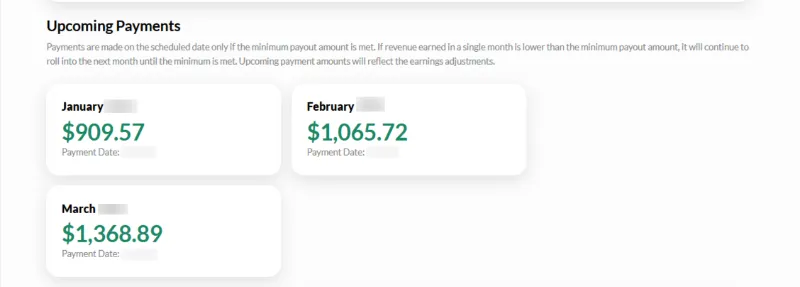
- Month 1: $909.57
- Month 2: $1,065.72
- Month 3: $1,368.89
That’s consistent, growing, passive income from a food blog.
Not life-changing numbers yet, but very real ones. And they keep climbing.
The best part? I’m not writing for brands. I’m not doing sponsored posts. I’m just answering questions people are already searching for in my kitchen niche.
What MyKitchenMates Is About
Mykitchenmates.com is a food and kitchen blog. I write helpful, detailed content around recipes, kitchen tips, ingredient guides, and cooking how-tos.
Think: the blog a home cook actually wants to read. Practical. Current. Written like a real person who has actually made the recipe.
That focus is the entire reason this works.
Step 1: Start Your Blog the Right Way (Without Overspending)
The biggest mistake new food bloggers make is overthinking the setup.
You do not need an expensive hosting plan. You do not need to hire a developer. You need something simple, fast, and affordable that you can actually manage yourself.
I use hostinger.com, and it’s been the best decision I made.
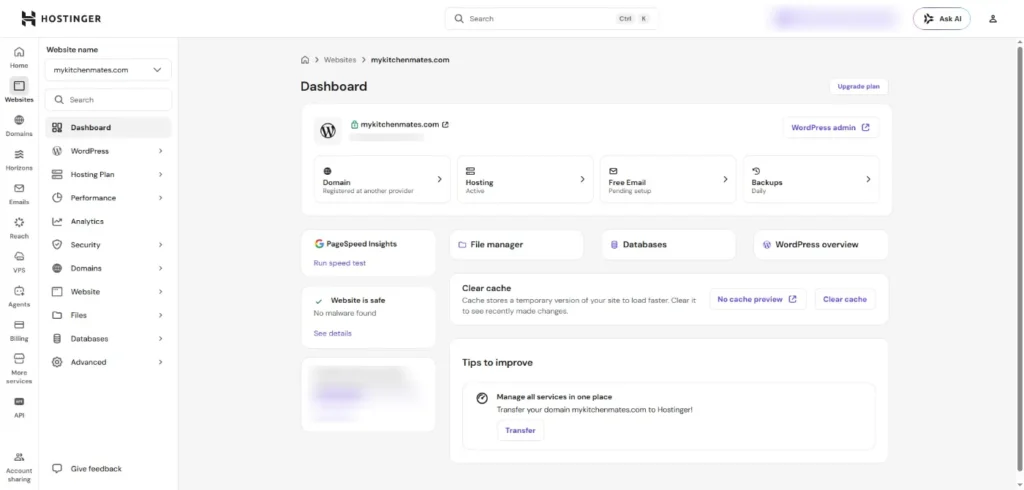
Here’s why I recommend it over the alternatives:
- It’s genuinely affordable, one of the cheapest reliable hosting options available
- The dashboard is clean and beginner-friendly (no tech background needed)
- Upgrading your plan as your blog grows is easy and takes minutes
- You get a free domain name included
- There’s a 30-day money-back guarantee, so there’s zero risk
I’m on the Professional Cloud Plan, which handles traffic growth really well without slowing down.
Get Hostinger here — this link gets you an extra 20% off, a free domain, and 2 months free on top of whatever plan you choose.
Or go straight to the Professional Cloud plan that I use: Hostinger Professional Cloud Plan
Once your hosting is set up, install WordPress. It takes about three minutes inside Hostinger. Then install a lightweight, fast theme and you’re ready to start writing.
Don’t get stuck here. A working blog beats a perfect-looking blog every time.
Step 2: Write 100+ Posts (Yes, Volume Actually Matters)
Here’s the honest truth about food blogging:
One post doesn’t make you money. A library of posts does.
I have over 700 articles on MyKitchenMates. That didn’t happen overnight. It happened one post at a time.
Every post I write answers a real question a home cook is searching for. Things like:
- “How long to bake chicken thighs at 400?”
- “What can I substitute for buttermilk?”
- “Easy weeknight pasta recipes with few ingredients”
- “How to tell if avocado is ripe”
These aren’t glamorous topics. But they’re what people actually type into Google and Pinterest at 5pm when they’re figuring out dinner.
The formula is simple: Question → Helpful Answer → Traffic → Income.
Each post I publish is another door into my blog. 700 posts = 700 doors. The more doors, the more traffic. The more traffic, the more ad income.
Step 3: Write in a Way People Actually Want to Read
This one is huge and most food bloggers get it wrong.
People are not coming to your blog to read your life story. They’re coming because they need help in the kitchen right now.
That means your content structure needs to serve them fast:
- Lead with the answer. Don’t bury it after three paragraphs of backstory.
- Use clear headings. Readers scan before they commit to reading.
- Include the latest information. Outdated posts lose trust. Update your content regularly.
- Write like a real human. Not a textbook. Not a robot. Like a knowledgeable friend who cooks.
I also keep my posts current. Cooking trends change. Ingredient availability changes.
If a post is a year old and still gets traffic, I update it so the information is fresh and accurate. Google rewards this. Readers trust this.
Step 4: Get Traffic From Pinterest Using the 1 Board Per URL Method

Pinterest is the fastest way to get a new food blog noticed.
Google SEO takes months. Pinterest can send you traffic within days of publishing a pin.
Here’s the exact method I use: 1 board for 1 URL.
Instead of pinning every post to a general “Recipes” board, I create a dedicated board for each blog post URL.
So my post on chicken thighs gets its own board. My post on pasta recipes gets its own board.
Why does this work?
- Pinterest can clearly understand what each board and each pin in it is about
- The board builds topical authority around that specific URL
- All pin clicks from that board go to one focused destination
- Pinterest’s algorithm rewards relevance, and nothing is more relevant than a board designed around one specific piece of content
With 700+ articles, I have hundreds of boards, each one supporting a specific post. That’s hundreds of consistent traffic sources feeding my blog every day.
Pinterest tips for food bloggers specifically:
- Vertical images perform best (1000 x 1500px, 1080 x 1920px)
- Use text overlays that answer the search query directly. “Easy 30-Minute Chicken Pasta” beats “Dinner Tonight”
- Keywords in your board name, board description, pin title, and pin description all matter
- Fresh pins (new images, even for old posts) keep your account active and visible
For keyword research, I use Pinclicks to find exactly what people are searching for on Pinterest. It takes the guesswork out of pin titles and descriptions completely.
For scheduling, I use Pin Generator to create and schedule my pins automatically.
It saves me hours every week, and there’s a lifetime deal available on AppSumo right now if you want to grab it at a steep discount.
Food content performs extremely well on Pinterest because it’s inherently visual. A great photo of a finished dish is already halfway to a click.
Step 5: Monetize With Ads Through Journey by Mediavine

Once your traffic grows, ads become your most reliable income stream.
I use Journey by Mediavine, and it’s the reason my income keeps climbing.
Journey is Mediavine’s ad program specifically built for growing blogs. The requirements are much more accessible than most people expect:
- At least 1,000 sessions over a 30-day period
- Original, brand-safe content
- An engaged audience
- Content that is regularly updated
- Enough premium traffic to offset non-premium traffic
That’s it. No massive traffic numbers required to get started.
Once you’re in, Journey places display ads across your blog automatically. You write the content. Readers visit. The ads run. You get paid on a set schedule, every month.
My month 1 to 3 payments came in at $909, $1,065, and $1,368 respectively. And those numbers have been growing every month as my traffic increases.
Apply for Journey by Mediavine here
The income isn’t instant. You need to build traffic first. But once you hit 1,000 sessions and get approved, the income runs in the background while you focus on writing.
Step 6: Add Affiliate Income on Top
Ads are my main income stream, but affiliate links add a steady layer on top with no extra effort.
For a food and kitchen blog, the most natural affiliate programs are:
- Amazon Associates — Kitchen tools, appliances, cookbooks, pantry staples. Almost every post has something linkable.
- Kitchen-specific retailers — If you recommend a specific cast iron pan, stand mixer, or knife set, link to it.
The key is to only recommend things you’ve actually used or would genuinely buy yourself. Readers trust you because you’re helpful and honest. The moment your links feel forced or salesy, you lose that trust.
I add affiliate links naturally inside my posts and let them earn quietly in the background.
What My Month Actually Looks Like
Here’s the reality of running a food blog as a real person with a real life:
Writing: I aim to publish new posts consistently. With 700+ articles already live, I also spend time updating older posts with fresh information, better photos, and improved recipes.
Pinterest: I use Pin Generator to create pins and schedule them out automatically so I’m pinning daily without having to be online every day.
SEO: Every post is written around a real search query. I use clear keyword-focused titles, proper headings, and internal links between related posts.
Income: Ads run automatically through Journey. Affiliate links are baked into the content. I don’t manage sponsors or pitch brands. The system runs itself.
Some months I write more. Some months I focus on updates and Pinterest. But every month, something goes out and something gets better.
Consistency, not perfection, is what compounds into income.
The Honest Timeline
If you’re just starting out, here’s what to realistically expect:
Month 1 to 3: Set up your blog. Write consistently. Learn Pinterest. Traffic is small.
Month 3 to 6: Posts start getting pinned and discovered. Traffic picks up. You’re building a foundation.
Month 6 to 12: Enough content and traffic to apply for Journey. Ad income starts. Affiliate income trickles in.
Year 2+: Income grows with traffic. Old posts compound. Pinterest picks up. SEO starts kicking in.
The blogs that fail quit in months 3 to 6. The blogs that succeed keep going through that slow period because they understand what they’re building.
It is not a sprint. It is a library that keeps getting bigger.
Your Next Step
You don’t need to figure everything out before you start.
You need:
- Hosting — Get Hostinger here (extra 20% off + free domain + 2 months free + 30-day money-back guarantee)
- A food niche you can write about for years
- A commitment to publishing consistently
- Pinterest as your traffic engine from day one
- A pin scheduling tool — Pin Generator (grab the lifetime deal on AppSumo while it’s available)
- Journey by Mediavine when you hit 1,000 sessions — Apply here
That’s the entire system. Content → Pinterest traffic → Ad income → Growth.
It works. I know it works because it’s working for me right now.
Start your blog. Write your first post. Pin it.
Then do it again tomorrow.
Have questions about getting started? Drop them in the comments. I read every single one.
Disclosure: This post contains affiliate links. I earn a small commission if you purchase through my links, at no extra cost to you. I only recommend products and services I use and trust.